Do Nofollow Links Help SEO? My Honest Answer With Examples
Hello guys, welcome back to my blog. One question I get almost every week from my clients and readers is do nofollow links help SEO or are they just a waste of time? Many new SEO people think if a link is nofollow then it is useless, and they just ignore it. I don’t agree with this fully. In this blog I will tell you what nofollow links are, what Google officially says about them, my own opinion after doing link building for years, and the 70/30 rule I follow for a natural backlink profile. I also made some simple infographics so you can understand everything easily. So lets start.
My quick answer
Nofollow links do not pass link juice (PageRank) in the normal way, so they will not directly push your rankings. But they are still very important. They make your backlink profile look natural, they bring real traffic and brand visibility, and many times they lead to dofollow links later. I keep around 70% dofollow and 30% nofollow in my link building.
Do Nofollow Links Help SEO or Not?
If you ask me directly, my answer is: nofollow links do not help SEO in the way dofollow links help. A dofollow link is like a vote. It passes authority, also called link juice, from one page to another page. A nofollow link has a small tag rel=”nofollow” which tells Google “I am linking to this page but I don’t want to vouch for it”. So the authority does not flow the same way.
However, SEO is not only about link juice. Google looks at your full link profile. If all your backlinks are dofollow and coming from blogs you contacted, it looks very planned. A natural website gets both types of links. This is why I say nofollow links help SEO indirectly, not directly.
One more thing, since 2019 Google calls nofollow a “hint” and not a strict rule, as you can read in the official Google Search Central blog. So Google can choose to use some nofollow links. But nobody outside Google knows which ones, so in my own planning I always count nofollow link juice as zero. I think this is the safe way to think about it.
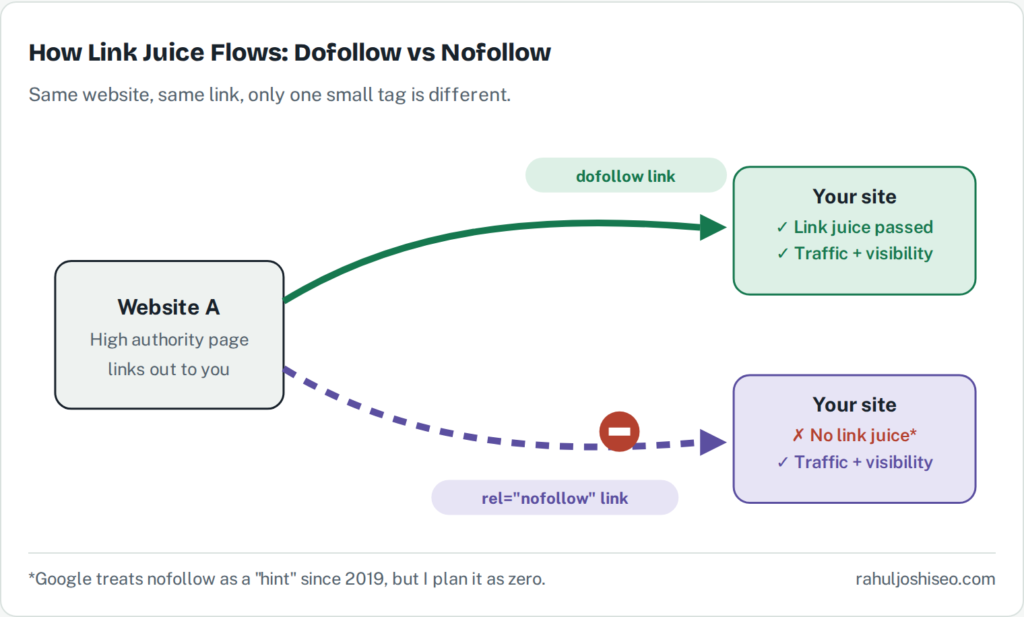
Image: do-nofollow-links-help-seo-link-juice-flow.png — Alt text: How link juice flows: dofollow vs nofollow
What Is a Nofollow Link, in Simple Words?
A nofollow link is a normal link with one extra attribute in the HTML code. Visitors can click it and go to your site like any other link. The only difference is for search engines. Here is how both look in code:
<!– Dofollow (normal link, no tag needed) –>
<a href=”https://example.com/”>Best SEO guide</a>
<!– Nofollow link –>
<a href=”https://example.com/” rel=”nofollow”>Best SEO guide</a>
As you can see, there is no such thing as a “dofollow” tag. A link is dofollow by default. Google’s qualify outbound links guide also says that for normal links you don’t need to add any rel attribute. If you are new to all this, you can first read my simple post on what are backlinks in SEO.
| Point | Dofollow Link | Nofollow Link |
|---|---|---|
| HTML tag | None (default) | rel=”nofollow” |
| Passes link juice | Yes | No (only a “hint” for Google) |
| Sends referral traffic | Yes | Yes |
| Builds brand visibility | Yes | Yes |
| Direct ranking boost | Yes | Very little or none |
| Where you see it most | Guest posts, editorial mentions, niche blogs | Wikipedia, big news sites, Quora, Reddit, comments |
| Spam risk if overdone | High (if paid or unnatural) | Low |
A Short History of Nofollow
Nofollow is not new. Google made it in 2005 to fight blog comment spam, because people were dropping thousands of links in comments to rank. Then in September 2019 Google changed the rules and added two new tags, sponsored and ugc. I made this small timeline so you can remember it easily.
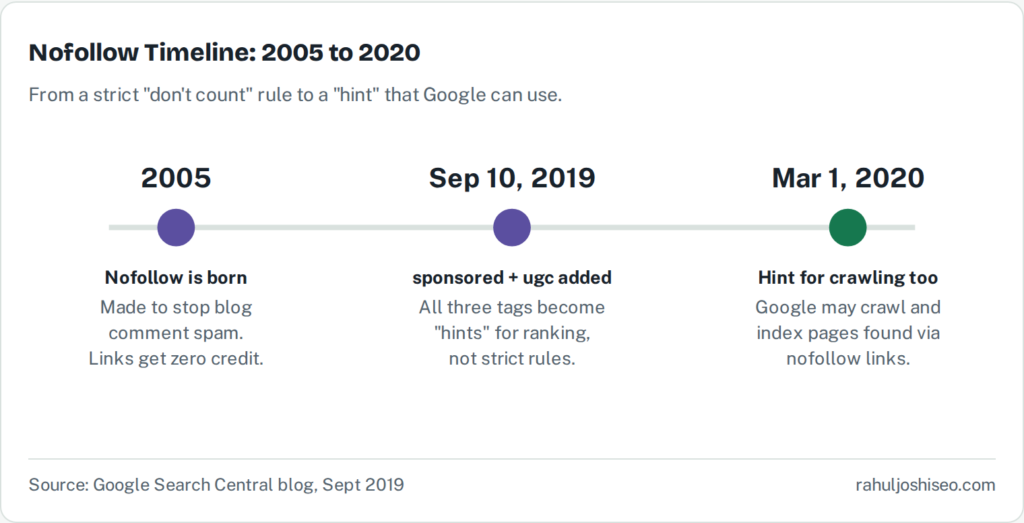
Image: nofollow-link-timeline-2005-2020.png — Alt text: Nofollow timeline 2005 to 2020
In that 2019 announcement, Google said that for crawling and indexing, nofollow becomes a hint from March 1, 2020. Honestly, I think Google did this because too many big websites were putting nofollow on every outbound link, and Google was losing useful data about the web.
Why I Still Build Nofollow Links (5 Real Benefits)
Even if nofollow links don’t pass link juice, I never skip them in my link building plan. Here are the 5 reasons, and I have seen all of them working on my own and client projects.
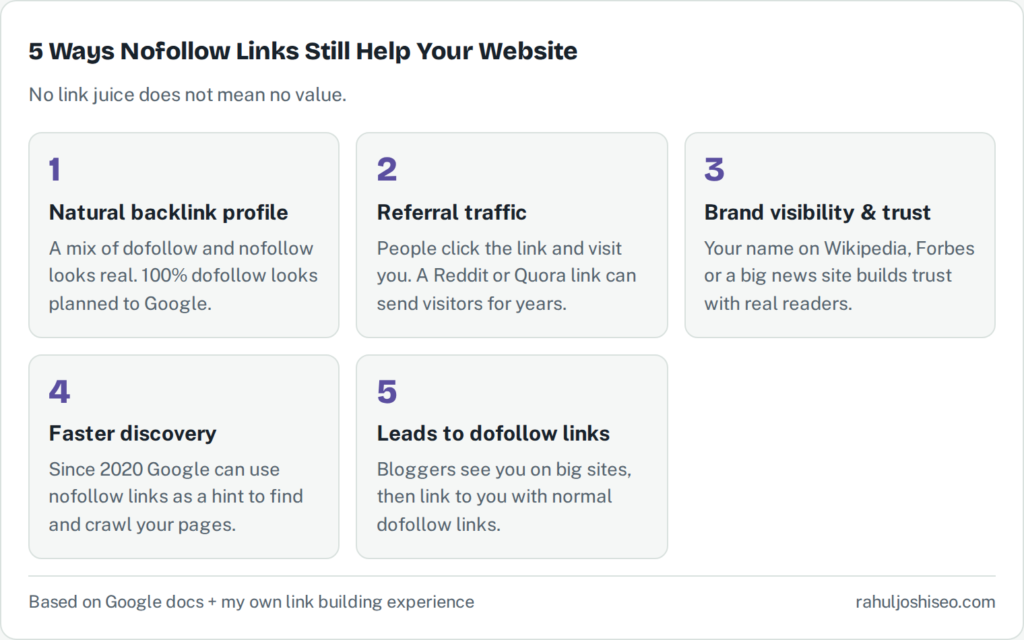
Image: benefits-of-nofollow-links.png — Alt text: 5 ways nofollow links help SEO
Point number 5 is my favourite. A content marketing agency called Fractl shared a nofollow link case study where one client saw a 271% increase in organic traffic after getting a nofollow link on BuzzFeed. The nofollow link itself did not pass juice, but many other websites saw the story and linked back. I think this is the real power of nofollow links from big sites.
Also, SEO expert Joy Hawkins from Sterling Sky did a small nofollow link test, where a nofollow link from a high ranking forum page helped her target page show in search results the next day. I don’t take one test as proof of anything, but it shows that the “zero value” thinking is too simple. More on traffic side, I have a separate guide on what is referral traffic.
My 70/30 Rule: Dofollow vs Nofollow Ratio
Now let me share the rule I personally follow. When I build links for a new website, I try to keep around 70% dofollow and 30% nofollow links. This is not a Google rule, Google never gave any ratio. It is my own rule from experience, and I think it keeps the profile looking natural and safe.
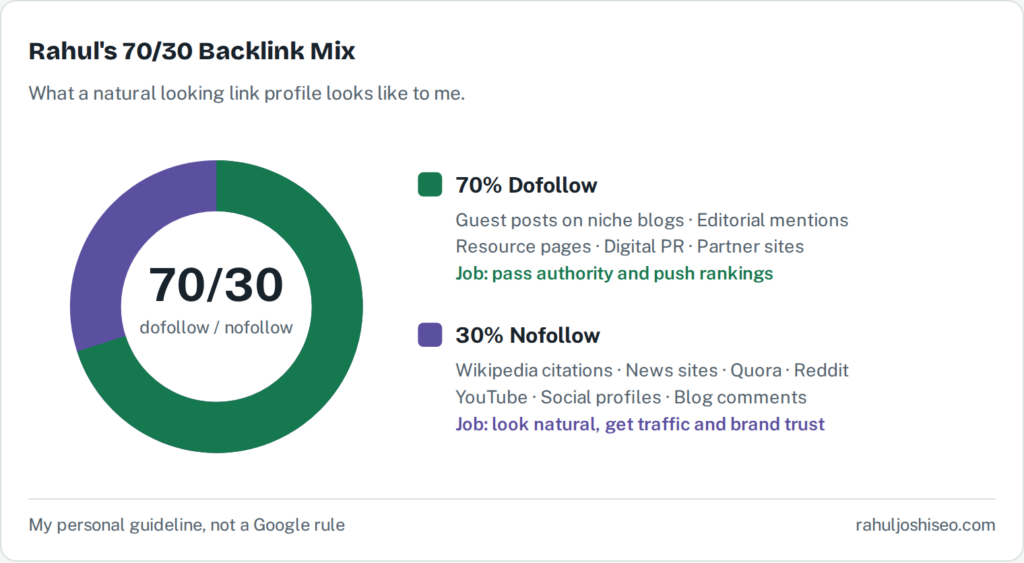
Image: dofollow-nofollow-ratio-70-30.png — Alt text: 70/30 dofollow nofollow ratio
To be fair, I should also tell you what real data says. Ahrefs studied the top 110k websites and found that 10.6% of all their backlinks are nofollow. So big sites have less nofollow then my 30%. But remember, those are huge brands that get thousands of editorial dofollow links naturally. For a small or new website doing active link building, I feel a bit higher nofollow share is healthier, because most of your dofollow links are coming from outreach. So don’t treat any number as magic. Use it as a range, somewhere between 20% to 35% nofollow is fine in my view.
| Example: 100 new backlinks | Link type | Count |
|---|---|---|
| Niche guest posts and editorial links | Dofollow | 45 |
| Resource pages, partners, digital PR | Dofollow | 25 |
| News, Wikipedia, Forbes type mentions | Nofollow | 8 |
| Quora, Reddit, forums (ugc) | Nofollow / ugc | 12 |
| Social profiles, YouTube, directories | Nofollow | 10 |
| Total | 70 dofollow / 30 nofollow | 100 |
Wikipedia Nofollow Link vs 0 DA Dofollow Link
This is the best example I can give you. If you give me a choice between a nofollow link from Wikipedia and a dofollow link from a 0 DA website, I will take the Wikipedia link every single time. All external links on Wikipedia are nofollow, you can see this on the Wikipedia nofollow page itself. Still, the value is far bigger. Look at this comparison.
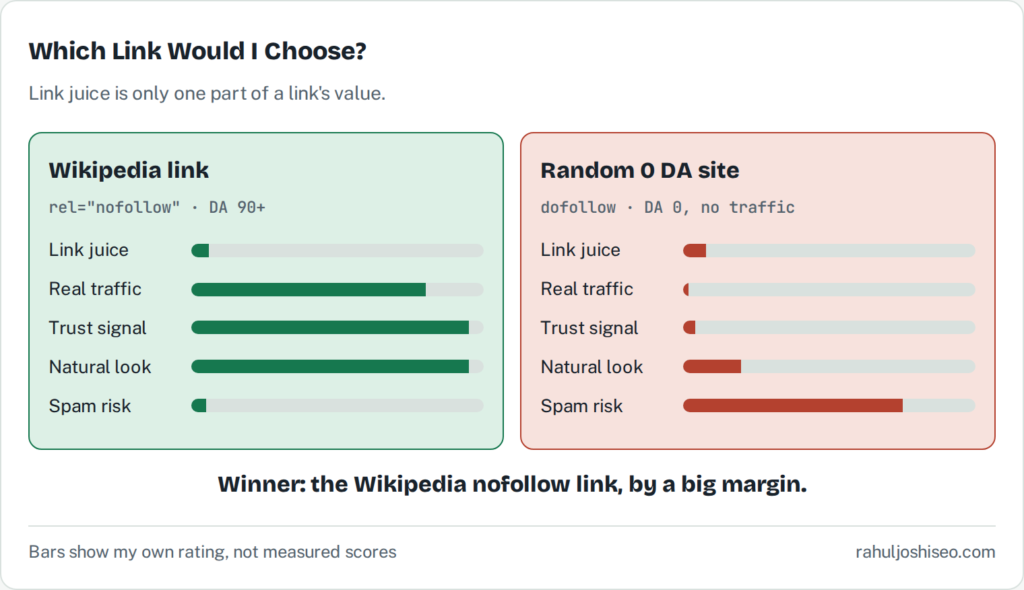
Image: wikipedia-nofollow-vs-0-da-dofollow-link.png — Alt text: Wikipedia nofollow link vs 0 DA dofollow link
Why? A 0 DA website has almost no authority to pass, so its “dofollow” is almost empty anyway. Many of these sites are also link farms, and Google’s spam policies on link schemes are very clear that manipulative links can hurt you. On the other side, Wikipedia is one of the most visited sites in the world. People read it, click the sources, and journalists and bloggers use it for research. So a Wikipedia citation can bring you traffic, trust and even new dofollow links from people who found you there.
One warning though. Please don’t spam Wikipedia. Editors remove promotional links very fast, and Wikipedia has strict external links rules. Only add your page as a source if it is really useful and adds real information.
Best Places to Get Good Nofollow Links
Not all nofollow links are equal also. A nofollow link from a real site with real visitors is worth much more then a comment link on a dead blog. These are the places I use most.
| Source | Usual tag | What you really get | My rating |
|---|---|---|---|
| Wikipedia (citation) | nofollow | Trust, research traffic, secondary links | Excellent |
| Big news & media sites | nofollow / sponsored | Brand authority, PR value | Excellent |
| Reddit threads | nofollow / ugc | Very targeted traffic, shows in Google & AI answers | Very good |
| Quora answers | nofollow | Long term traffic from question pages | Good |
| YouTube descriptions | nofollow | Traffic from video viewers | Good |
| Niche forums | ugc / nofollow | Community trust, some referral clicks | Good |
| Social profiles | nofollow | Brand signals, entity profile | Okay |
| Random blog comments | ugc / nofollow | Almost nothing, can look spammy | Avoid in bulk |
Nofollow, Sponsored and UGC: Quick Cheat Sheet
After 2019 there are 4 kinds of link tags you should know. If you want more detail on the user generated content one, I wrote a full post on what does UGC stand for.
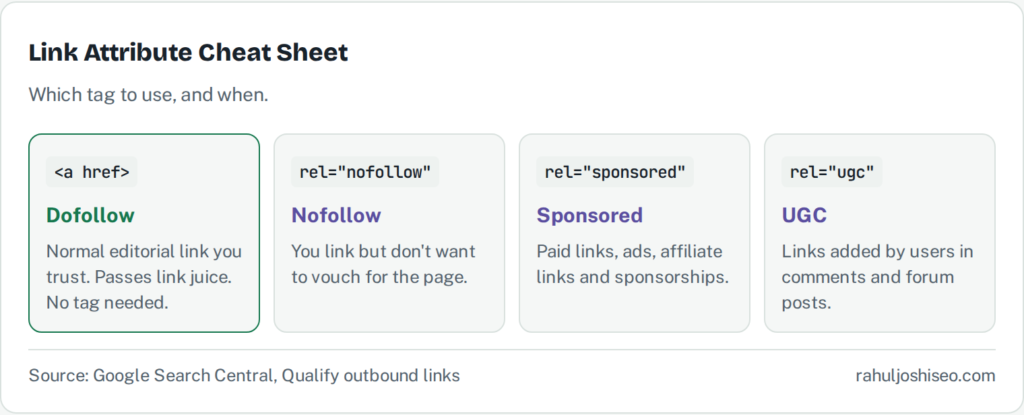
Image: nofollow-sponsored-ugc-cheat-sheet.png — Alt text: nofollow sponsored ugc cheat sheet
As per Google’s documentation, you can also combine them, for example rel=”nofollow sponsored”. For paid links Google prefers sponsored, but nofollow is still accepted. My advice is simple, if you paid for a link, mark it. Don’t try to hide it.
How to Check if a Link Is Nofollow
This is very easy and you can do it in 1 minute. I use these 3 ways:
- Inspect the link: Right click on the link in Chrome and click “Inspect”. The Chrome DevTools panel will open. If you see rel=”nofollow”, ugc or sponsored inside the <a> tag, it is not a normal dofollow link.
- Use a backlink tool: The free Ahrefs backlink checker shows dofollow and nofollow backlinks for any site. Paid tools like Semrush also show your full ratio.
- Check Google Search Console: The Links report in Google Search Console shows which sites link to you. It does not split by tag, but it shows what Google has found.
Common Nofollow Mistakes I See
- Ignoring every nofollow opportunity, even from sites like Forbes or Wikipedia, only because it is “not dofollow”.
- Going the other way and building thousands of spammy nofollow comment links. Quantity of junk does not help.
- Buying dofollow links from 0 DA sites just to hit a dofollow number. This is risky and mostly useless.
- Using the same exact match anchor text on every link. Keep it mixed, my guide on what is anchor text in SEO explains this.
- Not marking paid links as sponsored or nofollow on your own website. This is against Google’s guidelines.
- Never checking your link profile. If you find bad links, you can learn how to disavow links in my other post.
Quick Facts About Nofollow Links
| Introduced by Google | 2005, to stop comment spam |
| Became a “hint” for ranking | September 10, 2019 |
| Became a “hint” for crawling | March 1, 2020 |
| New tags added | rel=”sponsored” and rel=”ugc” |
| Share of nofollow links to top 110k sites | 10.6% (Ahrefs study) |
| Wikipedia external links | All nofollow |
| Traffic lift from one nofollow BuzzFeed link | 271% organic traffic increase (Fractl case study) |
| My recommended mix | About 70% dofollow / 30% nofollow |
FAQ
Do nofollow links help SEO rankings directly?
Not really. They don’t pass link juice like dofollow links. Google treats them as a hint, so some small value is possible, but I never count on it. Their main value is traffic, trust and a natural link profile.
Is a nofollow backlink worth getting?
Yes, if it comes from a real website with real visitors, like Wikipedia, a news site or an active Reddit thread. A nofollow link from a spammy page is not worth your time.
What is a good dofollow to nofollow ratio?
Google has no official ratio. I personally aim for around 70% dofollow and 30% nofollow for new sites. Ahrefs found big sites have about 10.6% nofollow, so anything in a natural range is fine.
Can nofollow links hurt my website?
Normally no. Only if you build thousands of spammy nofollow links in a very unnatural way, it can still look like manipulation.
Are Wikipedia links nofollow?
Yes, all external links on Wikipedia are nofollow. Still, I think a genuine Wikipedia citation is one of the best links you can get.
Final Words
So guys, this was my full guide on nofollow links. In short, nofollow links do not pass link juice, so don’t expect them to push your rankings alone. But they make your backlink profile natural, they bring real visitors, and a good one from a big site can open doors to many dofollow links. That’s why I follow the 70/30 rule and always go for quality over the tag. A nofollow link from Wikipedia beats a dofollow link from a 0 DA site any day. Keep on visiting my blog for more simple SEO guides like this one.
Sources
- Google Search Central Blog – Evolving “nofollow”
- Google Search Central – Qualify Outbound Links
- Google Search Central – Spam Policies (Link Spam)
- Ahrefs – The State of Nofollow, UGC & Sponsored
- Fractl – The Hidden Value of a Nofollow Link
- Sterling Sky – Do Nofollow Links Impact Your SEO?
- Wikipedia – Nofollow
- Wikipedia – External Links Guideline
Also Read: